I’ve been building guitars since 2003 and repairing them professionally since I opened Marfione Guitars in 2012. Building and repairing are different disciplines—many luthiers don’t take on repairs, and many excellent repair techs never build. I’ve always done both, and that experience informs every decision I make at the bench.
I work on classical, flamenco, crossover, nylon-string, and steel-string acoustics. Whatever the instrument, my goal is the same: to make the repair disappear into the guitar so that what you notice isn’t the work—it’s how much better the guitar plays and sounds.
Customers often tell me they appreciate that I listen first. One review mentioned my “extensive knowledge, attention to detail, and desire to provide the best service and outcomes,” but what matters most to me is simple: you trust me with an instrument that matters to you, and I take that trust seriously.
Contact MeSome repairs are about saving a guitar—top and side cracks, loose braces, lifting bridges and seam separations. Others are about making a guitar you already love feel better in your hands through fretwork, nut and saddle work, and careful attention to action, relief, and neck geometry.
A Taylor owner who brought me a cracked top said the repair was “barely noticeable” and that it was clear the work was done by a real luthier. Another client with a badly cracked side told me his guitar came back “masterfully repaired,” with the action restored to where it belonged—so it played like the day it first drew him in.
Small details can also transform an instrument. One Gretsch 5422TG owner came in frustrated by tuning issues and odd harmonics. After installing a roller bridge, upgrading the Bigsby, fitting Waverly tuners, and dialing in the geometry, he told me it felt more like a White Falcon than the mid-level guitar he’d started with.
Whether it’s structural work or fine-tuning playability, the aim is the same: a guitar that feels solid, inspires confidence, and lets you play without fighting the instrument.
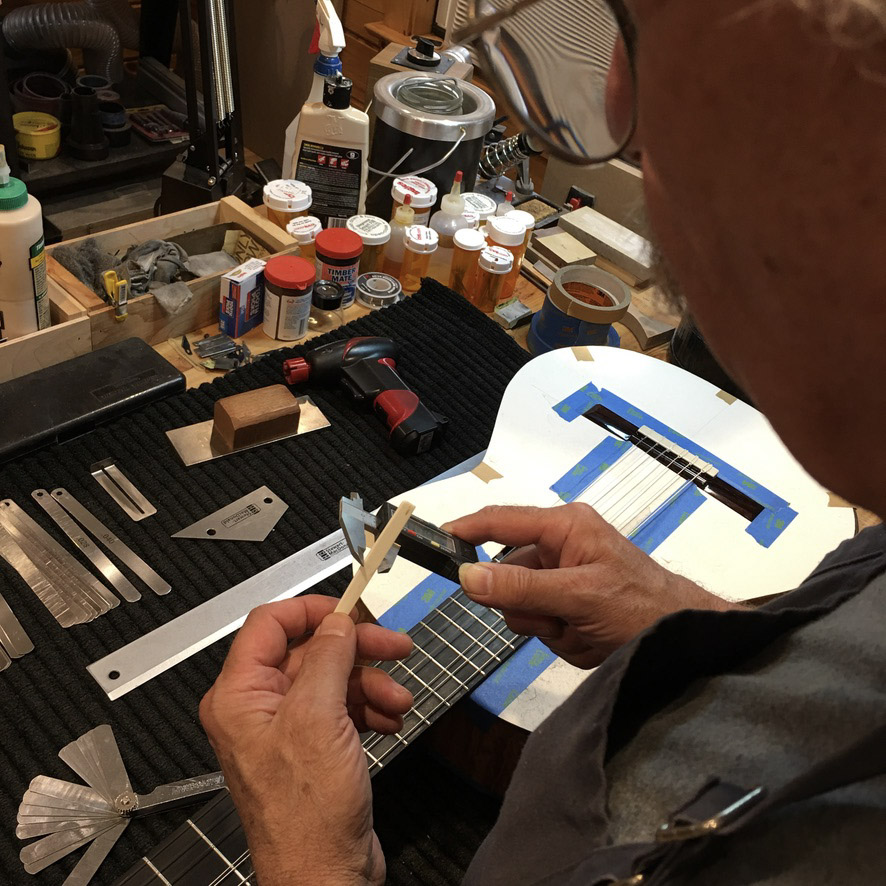
Not every guitar should be repaired, and not every repair is worth the investment. We’ll talk openly about what the guitar is, what it means to you, and what the work will realistically cost. Some instruments are worth fixing because of their market value; others because of their sentimental value. Both are valid—as long as you have the information to decide.
A client who has trusted me with his Collings D2HA, Martin D-18, and OM-21 over the years said I was the most “knowledgeable, competent, and honest luthier” he’d worked with in 50 years of playing. What mattered most to him was that I communicated every step of the way and never did anything without his approval. That’s the standard I try to uphold with everyone.
Sometimes the right call is a structurally sound, less-than-perfect cosmetic fix that respects your budget. Other times—especially with guitars that carry a lot of personal history—you may choose to invest more than the instrument is technically “worth.” My job is not to push you either way, but to give you clear options so you can make an informed decision you’re comfortable with.
When you bring a guitar in, we start with a simple conversation and a hands-on evaluation. You tell me what you’re hearing and feeling; I tell you what I see—structurally and in terms of playability—in plain language.
From there, I’ll outline practical options and realistic costs. Some repairs are “must-do,” others are optional refinements. You decide how far to go. There’s no pressure and no surprise work done without your approval.
Once the work is completed, I test-play the guitar myself and make any final tweaks. When you pick it up, we’ll go over what I did and how the guitar responds differently from when it came in.
If something doesn’t feel quite right once you’ve lived with it for a bit, I want to hear from you. My goal is that you leave with more confidence in your instrument—and in the person working on it.
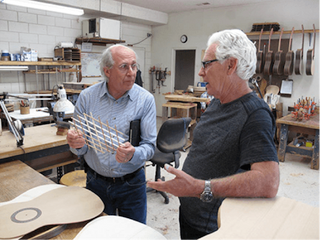
Whether you need a crack stabilized, fretwork refined, or the whole instrument brought back into alignment, I’ll work with you to make sure your guitar plays and sounds the way you’ve always hoped it could.
Contact Me